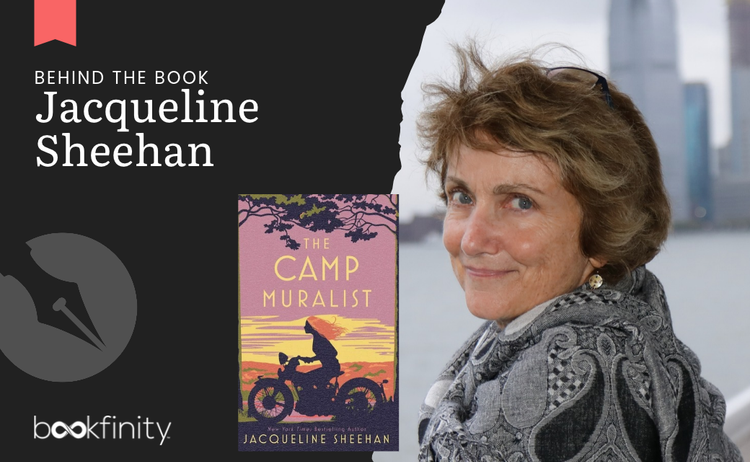
nyt bestselling author jacqueline sheehan on her first indie release
Jacqueline Sheehan, psychologist and New York Times bestselling author, is a New Englander through and through, though she spent twenty adventuresome years in Oregon, California, and New Mexico exploring house painting, photography, journalism, and directing a traveling troupe of high school puppeteers before returning to the East Coast. Her six previous novels: The Comet's Tale, Lost & Found, Now & Then, Picture This, The Center of the World, and The Tiger in the House have sold widely and are translated into eight languages. She has been supported by fellowships at Hawthornden Castle, MacDowell, and Jentel. She teaches writing through Writers in Progress in Massachusetts and leads international writing retreats in Guatemala.
The Camp Muralist
by Jacqueline Sheehan
"A haunting story of art, courage, and the unfinished business of history. A timely story everyone should read." -Jamie Ford, New York Times bestselling author of Hotel on the Corner of Bitter and Sweet
Two women are separated by fifty years and one dark American secret.
In 1938, aspiring artist Emma Lundgren is hired to paint a mural at a German American youth camp bordering her rural Connecticut home. Seeking a chance to practice her craft, she soon befriends a mistreated young boy inside who doesn't seem to fit the "ideals" the camp demands. With every stroke of her brush, Emma uncovers a chilling devotion to the Third Reich, risking everything to bring attention to the Nazi agenda rooting itself in American soil.
More than half a century later, celebrated chef Lily Milan is picking up the pieces of her fractured life when a shocking revelation threatens to upend everything she knows: Her entire identity is a lie, built on a mysterious adoption. Her quest for answers leads her to Emma-the grandmother who has spent decades searching for her.
As past and present collide, Lily becomes the key to unearthing a sinister history. Together, they face the enduring echoes of fanaticism, proving that even the longest shadows of trauma can be shattered by the resilient power of love.
Interview with jacqueline sheehan:
The Camp Muralist uncovers a disturbing chapter of American history that many readers may not know about. Do you remember the moment when you first encountered this history and realized there was a novel waiting to be written?
I grew up in a small town in Connecticut, but I had an adventuresome spirit that drew me out West as soon as I graduated from college. I continued to live in Western states for another twenty years. But I remained attached to my town, Southbury, and visited my family often. On one visit, I learned that my sister had just attended a lecture about something called a German American Bund camp that had been established in our town in 1937 and that it had a strong allegiance to the Nazi party in Germany. It sounded incredible, unlikely, and almost preposterous. “Where was it?” I asked. “Two miles from our home,” she said. From that moment onward, I knew that it would become the background for a novel and that I wanted to examine this nearly forgotten part of history.
Why did you choose a muralist as your protagonist? What is the importance of art in the story?
Emma is an aspiring artist and jumps eagerly at her first commission, painting a mural in the Bund Camp. And nothing could be farther from her mind than the power of using art as propaganda. The two worlds of art and warfare are at opposite ends of humanity and thus provide a ticking kind of tension. They rub against each other in a catalytic way. And there is a powerful irony etched into the story that her art career began under the supervision of a devoted Nazi.
How would you describe your creative process over the course of writing this novel?
My creative process is essentially the same for every book. When a story starts to form, often from something in daily life, I immerse myself in research that supports the story. In this case, the research had to do with the culture in the US around 1938: what was brewing in the sensibilities of the public, what the sentiment was about Hitler’s growing power in Europe, how the Depression affected lives, what it was like to be a nurse in 1938, what the daily wage was, etc. There was second timeline in the novel, 1991, with Emma’s granddaughter Emma. I needed to learn about women who struggled to work their way up in the culinary world, facing misogynistic barriers every step of the way. I was intrigued with the more contemporary Erin French, the dynamic and innovative chef from The Lost Kitchen in Maine. French had to rebuild her career after an abysmal failure and this was my guide when Lily went from stunning success to a humiliating bankruptcy
Historical research can establish what happened, but fiction can imagine what it felt like to live through it. What can a novelist explore about history that a factual account might leave untouched, and where do you draw the line between imaginative freedom and historical responsibility?
When I was in high school, I was a terrible history student. At least I was until one teacher, Nancy Cousins, took us on a field trip to Sturbridge Village in Massachusetts, and instructed us to write a story about the lives of people who lived in the seventeenth century. Once I imagined stepping into the daily lives of real people, their world came alive. I dove into research without one bit of prodding from my teacher. I wanted to know what kind of underwear they wore, what they ate, how they took care of their teeth, and only then did the larger questions emerge. What did they believe about religion, about the roles of men and women, and what were their aspirations. The fictional approach opened doors to the factual account, which is how I always think about historical fiction. Historical fiction must tell a compelling story, and it hopefully leads readers to exploring the actual account or to experience people from the past as real people with loves and losses.
What was the most surprising or unsettling discovery you made while researching the novel? Was there a historical detail that changed your understanding of the story or forced you to rethink a scene?
The most unsettling thing that became clear to me while researching for The Camp Muralist is how seductive something like fascism can be when it is paired with patriotism. People are vulnerable to grand promises when they are desperate, and years of suffering under the Depression created fertile ground with nearly one quarter of the population unemployed. Fictionally, I also had to create doubt in the townspeople who didn’t want to imagine that anything like a paramilitary camp had taken hold in their rural town. I began to look at other historical time periods and saw the same dynamics playing out with people being manipulated into viewing others (in Emma’s time period those were Jews, people of color, and virtually anyone who wasn’t from a “pure race”) again and again, but I also began to take a longer view of history and saw that people push back and defy autocratic governments. It gave me hope.
Emma's story and Lily's story are separated by roughly fifty years. What interested you about examining the same family history from two different points in time? Did one woman's story come to you before the other's?
Although Emma’s story is bigger and the consequences of her experience in the Bund Camp reverberate for fifty years, Lily’s story came to me first. I was mulling over the idea of how some people come back from the brink of personal disaster while some people are broken forever. Why do some people thrive and some don’t? When I was confronted with the history of the German Bund camps, I knew there would be a link between the two women. I am also the family genealogist, and I feel the connection to my ancestors in a powerful way. The link between Emma and her granddaughter Lily had been profound enough to bring them together, even with the passage of time and geography.
Your characters often face insurmountable situations: an enslaved child and young woman, a stalking boyfriend, time travel, drug traffic in rural Maine, etc. As a psychologist, why do you think that readers are attracted to stories of high stakes and dangerous odds?
From a psychological point of view, I understand why readers are thrilled to vicariously experience the dangerous and seemingly insurmountable odds that I create for my characters. I have often said, you simply don’t want to be one of my characters. If the writing goes as it should, the reader will have a full sensory experience. Brain scans have revealed that if we imagine, or read, about a character running for their life along a steep mountain trail, for example, the same regions of our brain that are connected with physical exertion will fire up. And adrenaline will increase in the reader. There is something ancient about storytelling. We want to be immersed in the story, feel the conflict, and search for the resolution.
What have your experiences teaching writing and leading retreats taught you about creativity and storytelling?
I took a group of writers to Guatemala this summer, along with Jane Mortifee, my coleader. It always astounds me how deeply writers can go if they are cared for, given the time to write, and given the meaningful support of leaders. Every time a writer commits to a workshop or a retreat, it is a clear message to the unconscious that their creative self is being honored and recognized. The message to me is to remember to do the same thing; respect creativity by feeding it with time, being with other writers, and fueling my creativity by fully participating in the world around me.
If you were to genre-hop and write a completely different type of content, what do you think it would be?
This question made me laugh because I am a hardcore genre-hopper, not because I set out to do so, but because I am drawn to stories that intrigue me, and they rarely behave themselves by sticking to one genre. A writer friend refers to me as genre-fluid. My next book is part memoir, which I swore I would never write, yet here it is, a story about my sister Fran who had an intellectual disability, but who was also my caretaker when I was a young child. It is about our relationship and the evolution of neurodiversity and learning disabilities. That’s a big genre-hop even for me.
And more!
Check out Jacqueline Sheehan's The Camp Muralist and discover a gripping story of courage, identity and a little-known chapter of American history.
Check out Jacqueline's website, and be sure to follow her on Instagram and Facebook to stay in the loop with her work!
Ready to share your story like Jacqueline? Start publishing your historical fiction novel with IngramSpark today!