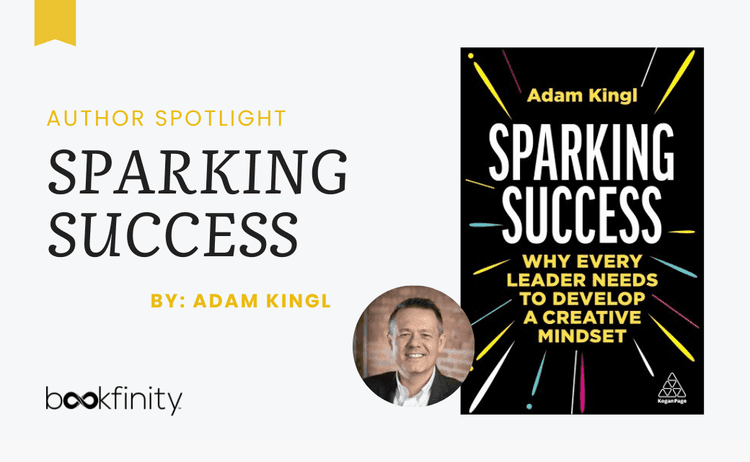
Adam Kingl- Author Spotlight
Adam Kingl is a speaker, educator, adviser and author who specializes in the

areas of leadership creativity, innovation and adaptability. He is an adjunct faculty member at the UCL School of Management and Hult Ashridge Business School, and is an instructor at Imperial College London, Sauder Business School, the Irish Management Institute at University College Cork, and Headspring Executive Development. Adam Kingl is also an Associate of the Moller Leadership Institute at Churchill College, University of Cambridge and has also been featured in publications such as the Financial Times, Sunday Times, Forbes, Fortune Magazine, The Guardian, and City AM. Adam Kingl is based in London, UK.
Sparking Success: Why Every Leader Needs to Develop a Creative Mindset
Sparking Success is a fascinating exploration of how you can spark a creative mindset that will lead to dramatic results for both you and your business. Revolutionize your leadership through the book's practical insights, supported by high-profile interviews and insightful case studies.
Studies show that 80% of people feel an increasing pressure to be productive rather than creative at work.
About The Book - Interview
Your book Sparking Success: Why Every Leader Needs to Develop a Creative Mindset launched in April, congratulations! What should readers take away after reading this book?
Some companies assume that creativity is only necessary for the realm of media, communications and arts organisations. However, in a highly volatile world, the ability to innovate your management and business models, processes, products and services at scale and speed is critical. Creativity is an absolute requirement, and any company in any industry can be highly innovative.
How did you come up with the overall focus/theme for Sparking Success: Why Every Leader Needs to Develop a Creative Mindset?
I was struck by the results of two separate global surveys that were issued just a few years ago. In one, most CEOs reported that innovation is a top three priority for their companies. On the other, employees in the rank and file suggested that their organisations were very bad at practicing innovation. I’m not sure that there’s a bigger gap between aspiration and reality in our world of work today.
Did you ever envision yourself being an expert on creativity in leadership? Were you just born a creative leader, or did you have to learn these things yourself?
My first career was as a theatre director, so I’ve always thought of myself as creative. I have a Master’s in Fine Arts and a Master’s in Business Administration, and with every passing year, I’m convinced that the creative and corporate worlds have much to learn from each other.
How do you think creativity fuels success?
We know we live in a rapidly changing world, but it’s more dramatic than that. The rate (or delta) of change is increasing. So, the ability to invent, reinvent and adapt is the only skill that truly enhances a business’ chance of not only success but survival.
Why is creativity important in a company’s work environment?
I haven’t seen or heard much to date from the corporate world about learning from arts organisations, yet there are so many universally applicable lessons: how to lead teams and meetings, develop new ideas, foster new products and services or innovate strategies. Too many companies immediately dismiss that they can learn from media, artistic and entertainment organisations.
If we believe that creativity is a necessary competence in any industry, then it stands to reason that there must be a wealth of learning from organizations whose very lifeblood is in being supremely creative every day.
Kingl's Advice for Leaders:
What is one way that leaders stifle creativity? Any tips for leaders on how to not fall into this trap?
I’ve discovered the primary reason leaders stifle creativity is that they do not support their team’s proposing many ideas, no matter how ridiculous they at first appear. Value-adding innovation is more a product of soliciting a volume of ideas, and then exploring them, rather than encouraging the team only to propose that one perfect idea. Some ideas really are just silly, but others become not only viable but exciting when they are discussed among the team. But if the leader shoots down any idea that isn’t immediately practical, quick, inexpensive and has a measurable ROI, then that leader quickly finds that their team no longer proposes any idea at all for fear of appearing stupid or unreasonable.
What is a resource or piece of advice that you would give to a leader new to the role?
In addition to reading my books Sparking Success and Next Generation Leadership? LOL! I would say leaders need to lean into curiosity rather than expertise a lot more. In other words, assume you know less than you think or that your knowledge of customers or what motivates your team may be different from what you learned years ago. Gone are the days when leaders can rely on wisdom.
In fact, the more senior you become, the more separated you are from what’s really happening in the market, among your competitors or substitutes, or on the shop floor. One of the best remedies to this condition is to stay curious and actively ask questions, assuming your understanding is out of date.
What do you think is the ideal balance of productivity vs creativity in a leader’s team?
Productivity and creativity are not mutually exclusive.
If improvements to processes and efficiencies are a product of innovation, then these two dynamics support each other. In fact, if anything, an innovative approach opens more possibilities for exponential improvements versus tiny, incremental ones, which occur in a philosophy of only managerial control and scientific management.
Kingl's Advice for Employees:
What would you tell an employee that was feeling stifled creatively in the workplace? How would you suggest they address the issue with leadership or management?
Encourage one’s team and manager to practice more ‘Yes and…’ versus ‘Yes but…’. Colleagues and leaders sometimes assume that in a professional context their job is immediately to figure out why something won’t work. You can always find a reason if you’re pessimistic enough! We think we’re being supportive by saying ‘Yes but…’. Let’s be honest, ‘Yes but…’ simply means no. Keep using it and no one will bother you anymore with new ideas in short order! Remember that you don’t have to implement an idea if you respond with ‘Yes and…’ but that simple verbal tick pushes you to explore the idea that little bit further. So even if you don’t end up doing it, the person who suggested it knows you validate their thinking by giving them the courtesy of considering it for a minute.