Get informed with these books about natural disasters!
Discover gripping reads about natural disasters in these compelling books. Explore stories of survival, resilience, and human spirit as these authors vividly depict earthquakes, hurricanes, tsunamis, and more. Dive into these thrilling narratives to experience the raw power of nature and the indomitable courage of those facing its wrath. Whether you're fascinated by geology, climatology, or human resilience, these books will captivate and educate. Get ready to be swept away by these captivating books about natural disasters.
Be prepared. Be Informed. It can happen to anyone.
Books about natural disasters:
And Soon I Heard a Roaring Wind: A Natural History of Moving Air
by Bill Streever
A thrilling exploration of the science and history of wind from the bestselling author of Cold.
Scientist and bestselling nature writer Bill Streever goes to any extreme to explore wind -- the winds that built empires, the storms that wreck them -- by traveling right through it. Narrating from a fifty-year-old sailboat, Streever leads readers through the world's first forecasts, Chaos Theory, and a future affected by climate change. Along the way, he shares stories of wind-riding spiders, wind-sculpted landscapes, wind-generated power, wind-tossed airplanes, and the uncomfortable interactions between wind and wars, drawing from natural science, history, business, travel, as well as from his own travels.
And Soon I Heard a Roaring Wind is an effortless personal narrative featuring the keen observations, scientific rigor, and whimsy that readers love. You'll never see a breeze in the same light again.
Apocalypse Ready: The Manual of Manuals; A Century of Panic Prevention
by Taras Young
Global warming continues to cause extreme weather events and threatens to destroy the planet, while the impact of the COVID-19 pandemic has reminded us that disaster can manifest at any time. These and other possible impending catastrophes have caused rising levels of collective fear in nations around the world, and increasing demand for governments to plan, prepare, and avert calamity for its citizens. In Apocalypse Ready, Taras Young collects official survival and emergency documents from the United States to the Soviet Union offering essential survival tips and invaluable life-saving strategies for every possible cataclysmic eventuality.
Organized into four broad disaster-themed scenarios--"Pandemics," "Natural Disasters," "Nuclear War," and "Alien Invasion"--this unique collection displays a plethora of questionable survival advice and scare tactics from all around the globe for response to every disaster scenario that has occurred or been imagined since the early twentieth century.
Be a Hero: The Essential Survival Guide to Active-Shooter Events
by John Geddes - Alun Rees - Don Mann
It's never going to be you. Then one day you hear the clatter of automatic fire at the mall. You have been drawn into the chaos and terror of an active shooter event. What do you do? Who do you turn to?
Be a Hero is the essential guide to terrorist attacks that will help you survive. Former Special Air Service terror expert John Geddes will explain how to cope with a life-threatening event. He shows you how to make clear decisions and beat the odds by:
Dealing with fear through simple and effective techniques to bring the chemical urges generated by terror at least partially under control
Escaping and evading when possible, using everyday objects and landmarks for protection
Fighting back if needed, with methods to disarm an active shooter and to use items at hand as weapons
Using a weapon if you are licensed to carry, shooting to kill without collateral damage or being mistaken for a perpetrator
Providing medical assistance to deal with traumatic battlefield injury and save lives
Cure for Catastrophe: How We Can Stop Manufacturing Natural Disasters
by Robert Muir-Wood
We can't stop natural disasters but we can stop them being disastrous. One of the world's foremost risk experts tells us how.
Year after year, floods wreck people's homes and livelihoods, earthquakes tear communities apart, and tornadoes uproot whole towns. Natural disasters cause destruction and despair. But does it have to be this way?
In The Cure for Catastrophe, global risk expert Robert Muir-Wood argues that our natural disasters are in fact human ones: We build in the wrong places and in the wrong way, putting brick buildings in earthquake country, timber ones in fire zones, and coastal cities in the paths of hurricanes. We then blindly trust our flood walls and disaster preparations, and when they fail, catastrophes become even more deadly. No society is immune to the twin dangers of complacency and heedless development.
Death in the Air: The True Story of a Serial Killer, the Great London Smog, and the Strangling of a City
by Kate Winkler Dawson
A real-life thriller in the vein of The Devil in the White City, Kate Winkler Dawson's debut Death in the Air is a gripping, historical narrative of a serial killer, an environmental disaster, and an iconic city struggling to regain its footing.
London was still recovering from the devastation of World War II when another disaster hit: for five long days in December 1952, a killer smog held the city firmly in its grip and refused to let go. Day became night, mass transit ground to a halt, criminals roamed the streets, and some 12,000 people died from the poisonous air. But in the chaotic aftermath, another killer was stalking the streets, using the fog as a cloak for his crimes.
All across London, women were going missing--poor women, forgotten women. Their disappearances caused little alarm, but each of them had one thing in common: they had the misfortune of meeting a quiet, unassuming man, John Reginald Christie, who invited them back to his decrepit Notting Hill flat during that dark winter. They never left.
“Without a doubt, put this on the top books about natural disasters!” - booklist starred review
Field Guide to the Apocalypse: A Mostly Serious Guide to Surviving Our Wild Times
by Athena Aktipis
A common sense field guide to understanding, surviving, and thriving in our time of complex chaos and crises.
Is this finally it? The end times?Because from COVID-19 to climate catastrophe to the looming AI revolution--not to mention the ever-growing background hum of rage, fear, and anxiety--it's starting to feel like the party we call civilization is just about over. The good news? It's always felt that way.
Drawing on evolutionary psychology, history, brain science, game theory, and more, cooperation theorist (and, coincidentally, zombie expert) Athena Aktipis reassuringly explains how we, as a species, are hardwired to survive big existential crises. And how we can do so again by leveraging our innate abilities to communicate and cooperate.
Fire in Paradise: An American Tragedy
by Alastair Gee - Dani Anguiano
There is no precedent in postwar American history for the destruction of the town of Paradise, California. On November 8, 2018, the community of 27,000 people was swallowed by the ferocious Camp Fire, which razed virtually every home and killed at least 85 people. The catastrophe seared the American imagination, taking the front page of every major national newspaper and top billing on the news networks. It displaced tens of thousands of people, yielding a refugee crisis that continues to unfold.
Furious Sky: The Five-Hundred-Year History of America's Hurricanes
by Eric Jay Dolin
Hurricanes menace North America from June through November every year, each as powerful as 10,000 nuclear bombs. These megastorms will likely become more intense as the planet continues to warm, yet we too often treat them as local disasters and TV spectacles, unaware of how far-ranging their impact can be. As best-selling historian Eric Jay Dolin contends, we must look to our nation's past if we hope to comprehend the consequences of the hurricanes of the future.
With A Furious Sky, Dolin has created a vivid, sprawling account of our encounters with hurricanes, from the nameless storms that threatened Columbus's New World voyages to the destruction wrought in Puerto Rico by Hurricane Maria. Weaving a story of shipwrecks and devastated cities, of heroism and folly, Dolin introduces a rich cast of unlikely heroes, such as Benito Viñes, a nineteenth-century Jesuit priest whose innovative methods for predicting hurricanes saved countless lives, and puts us in the middle of the most devastating storms of the past, none worse than the Galveston Hurricane of 1900, which killed at least 6,000 people, the highest toll of any natural disaster in American history.
Geography of Risk: Epic Storms, Rising Seas, and the Cost of America's Coasts
by Gilbert M Gaul
This century has seen the costliest hurricanes in U.S. history--but who bears the brunt of these monster storms?
Consider this: Five of the most expensive hurricanes in history have made landfall since 2005: Katrina ($160 billion), Ike ($40 billion), Sandy ($72 billion), Harvey ($125 billion), and Maria ($90 billion). With more property than ever in harm's way, and the planet and oceans warming dangerously, it won't be long before we see a $250 billion hurricane. Why? Because Americans have built $3 trillion worth of property in some of the riskiest places on earth: barrier islands and coastal floodplains. And they have been encouraged to do so by what Gilbert M. Gaul reveals in The Geography of Risk to be a confounding array of federal subsidies, tax breaks, low-interest loans, grants, and government flood insurance that shift the risk of life at the beach from private investors to public taxpayers, radically distorting common notions of risk.
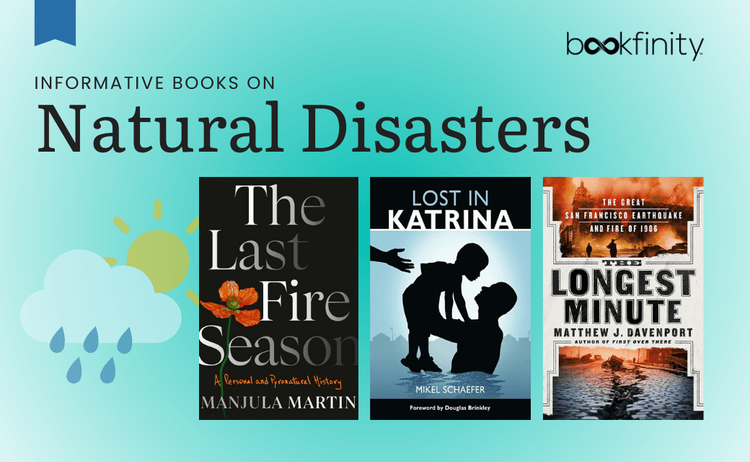
Last Fire Season: A Personal and Pyronatural History
by Manjula Martin
NATIONAL BESTSELLER - A MOST-ANTICIPATED BOOK: The New York Times, The Los Angeles Times, The San Francisco Chronicle, The Saturday Evening Post, Poets & Writers, The Millions, Alta, Heat Map News
Told in luminous, perceptive prose, The Last Fire Season is a deeply incisive inquiry into what it really means--now--to live in relationship to the elements of the natural world. When Manjula Martin moved from the city to the woods of Northern California, she wanted to be closer to the wilderness that she had loved as a child. She was also seeking refuge from a health crisis that left her with chronic pain, and found a sense of healing through tending her garden beneath the redwoods of Sonoma County. But the landscape that Martin treasured was an ecosystem already in crisis. Wildfires fueled by climate change were growing bigger and more frequent: each autumn, her garden filled with smoke and ash, and the local firehouse siren wailed deep into the night.
Longest Minute: The Great San Francisco Earthquake and Fire of 1906
by Matthew J Davenport
A New York Times Book Review Editor's Choice
Matthew J. Davenport's The Longest Minute is the spellbinding true story of the 1906 earthquake and fire in San Francisco, and how a great earthquake sparked a devastating and preventable firestorm.
At 5:12 a.m. on April 18, 1906, a 7.9 magnitude earthquake struck San Francisco, catching most of the city asleep. For approximately one minute, shockwaves buckled streets, shattered water mains, collapsed buildings, crushed hundreds of residents to death and trapped many alive. Fires ignited and blazed through dry wooden ruins and grew into a firestorm. For the next three days, flames devoured collapsed ruins, killed trapped survivors, and nearly destroyed what was then the largest city in the American West.
Lost in Katrina
by Mikel Schaefer - Douglas Brinkley
Emotional first-person accounts tell of the destruction faced by one parish on August 29, 2005, and the days that followed. While attention and resources were focused on New Orleans, survival became the ultimate goal of the neighboring parish of St. Bernard. An unprecedented 99 percent of the parish was submerged in water and almost all buildings were destroyed. Each account is filled with the heartwrenching reality of a community lost and the strength it took to rise again.
Megadisasters: The Science of Predicting the Next Catastrophe
by Florin Diacu
The history and science behind efforts to predict major disasters, from tsunamis to stock market crashes
Can we predict cataclysmic disasters such as earthquakes, volcanic eruptions, or stock market crashes? The Indian Ocean tsunami of 2004 claimed more than 200,000 lives. Hurricane Katrina killed over 1,800 people and devastated the city of New Orleans. The recent global financial crisis has cost corporations and ordinary people around the world billions of dollars. Megadisasters is a book that asks why catastrophes such as these catch us by surprise, and reveals the history and groundbreaking science behind efforts to forecast major disasters and minimize their destruction.
Each chapter of this exciting and eye-opening book explores a particular type of cataclysmic event and the research surrounding it, including earthquakes, tsunamis, volcanic eruptions, hurricanes, rapid climate change, collisions with asteroids or comets, pandemics, and financial crashes. Florin Diacu tells the harrowing true stories of people impacted by these terrible events, and of the scientists racing against time to predict when the next big disaster will strike.
Megafire: The Race to Extinguish a Deadly Epidemic of Flame
by Michael Kodas
As forest fires continue to ravage communities, this bestselling author and firefighter explores what causes them, and captures the danger and heroism of those who fight them
In Megafire, a world-renowned journalist and forest fire expert travels to the most dangerous and remote wildernesses, as well as to the backyards of people faced with these environmental disasters, to look at the heart of this phenomenon and witness firsthand the heroic efforts of the firefighters and scientists racing against time to stop it--or at least to tame these deadly flames.
From Colorado to California, China to Canada, the narrative hopscotches the globe and takes readers to the frontlines of the battle both on the ground and in the air, and in the laboratories, universities, and federal agencies where this issue rages on. Through this prism of perspectives, Kodas zeroes in on a handful of the most terrifying and tumultuous of these environmental disasters in recent years--the Yarnell Hill Fire in Arizona that took the lives of nineteen elite "hotshot" firefighters, the Waldo Canyon Fire that overwhelmed the city of Colorado Springs--and more in a page-turning narrative that puts a face on the brave people at the heart of this issue. Megafire describes the profound impact of these fires around the earth and will change the way we think about the environment and the essential precariousness of our world.
Paradise Found: A High School Football Team's Rise from the Ashes
by Bill Plaschke
From L.A. Times columnist and ESPN Around the Horn panelist Bill Plaschke, a story of tragedy, triumph, and the remarkable power of high school football in one small California town
On November 8, 2018, the Camp Fire ravaged the town of Paradise, California. The fire, which burned up to 80 acres per minute, killed 86 people, and nearly every building and home in the town was reduced to ashes. In a single day, Paradise, a proud working-class town in the foothills of the Sierra Nevadas, saw its population fall from 25,000 to 2,000.
The Paradise High football team had long been the town's source of joy and inspiration. But in the wake of the fire, their season was abruptly cancelled on the eve of the playoffs. Their championship hopes were gone. Their program's survival seemed doubtful--it wasn't even clear whether Paradise High would continue to exist.
Sugarcane Academy: How a New Orleans Teacher and His Storm-Struck Students Created a School to Remember
by Michael Tisserand
Hurricane Katrina devastated New Orleans, taking lives and livelihoods and displacing thousands. Because the hurricane struck at the beginning of the school year, the city's children were among those most affected. Michael Tisserand, former editor of the alternative cultural newspaper Gambit Weekly, evacuated with his family to New Iberia, Louisiana. Then, rather than waiting to find out when--or if--schools in New Orleans would reopen, Tisserand and other parents persuaded one of his children's teachers, Paul Reynaud, to start a school among the sugarcane fields.So was born the Sugarcane Academy--as the children themselves named it--and so also began an experience none of Reynaud's pupils will ever forget. This inspiring book shows how a dedicated teacher made the best out of the worst situation, and how the children of New Orleans, of all backgrounds and races, adjusted to Katrina's consequences.
Thousand-Year Flood: The Ohio-Mississippi Disaster of 1937
by David Welky
In the early days of 1937, the Ohio River, swollen by heavy winter rains, began rising. And rising. And rising. By the time the waters crested, the Ohio and Mississippi had climbed to record heights. Nearly four hundred people had died, while a million more had run from their homes. The deluge caused more than half a billion dollars of damage at a time when the Great Depression still battered the nation.
Timed to coincide with the flood's seventy-fifth anniversary, The Thousand-Year Flood is the first comprehensive history of one of the most destructive disasters in American history. David Welky first shows how decades of settlement put Ohio valley farms and towns at risk and how politicians and planners repeatedly ignored the dangers. Then he tells the gripping story of the river's inexorable rise: residents fled to refugee camps and higher ground, towns imposed martial law, prisoners rioted, Red Cross nurses endured terrifying conditions, and FDR dispatched thousands of relief workers. In a landscape fraught with dangers--from unmoored gas tanks that became floating bombs to powerful currents of filthy floodwaters that swept away whole towns--people hastily raised sandbag barricades, piled into overloaded rowboats, and marveled at water that stretched as far as the eye could see.
Year Yellowstone Burned: A Twenty-Five-Year Perspective
by Jeff Henry - Bob Barbee
The Yellowstone fires of 1988 consumed nearly 800,000 acres--36 percent of the park. In the years following, spectacular wildflowers rose from the ashes and trees rapidly reclaimed the landscape. In this twenty-five-year look back at the fires, author and photographer Jeff Henry recalls not only the summer of 1988, when he witnessed and photographed nearly every aspect of the fires, but also the years since as nature healed the charred landscape. A beautiful book that depicts nature as simultaneously malevolent and beneficent, The Year Yellowstone Burned demonstrates the resilience of one of our continent's most dynamic ecosystems.