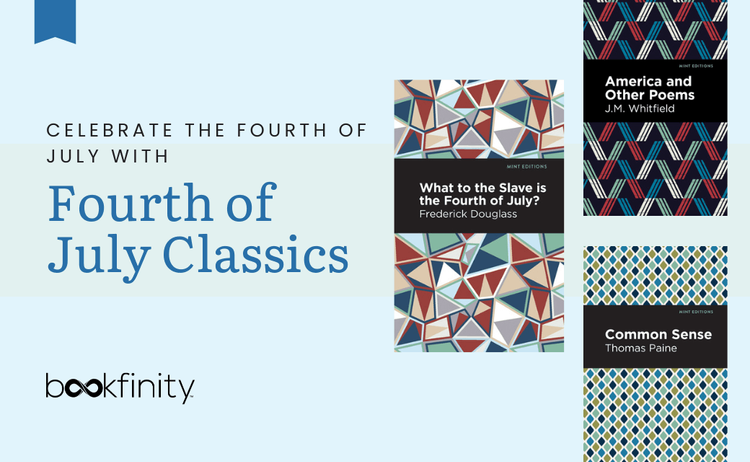
Celebrate the Forth of July with these Captivating Classics
As the Fourth of July approaches, it's the perfect time to reflect on the rich history and ideals that define the United States. What better way to honor this momentous day than to delve into the knowledge and fascinating writings of some of America's best thinkers? In this article, we present four Mint Edition classic books that are carefully selected to enrich your understanding of the Fourth of July. From the foundational documents of our nation to powerful speeches and poetic reflections, these books offer a captivating journey through American history and its core values.
The United States Constitution and Bill of Rights
by - Congress 1st United States
The United States Constitution and Bill of Rights (1787-1789) is a foundational document of American democracy. Written by delegates attending the Constitutional Convention, a gathering intended to revise the system of government established under the Articles of Confederation, The Constitution of the United States was ratified in 1788 before becoming effecting in 1789. Nearly two and a half centuries old, it is the oldest continually enforced national constitution in the world. The United States Bill of Rights, containing the first ten amendments to the Constitution, was ratified in 1791, codifying into law the essential individual rights and freedoms of Americans, setting limitations on government power, and diverting powers not specifically granted to Congress to the states and citizens.
"We the People." Beginning with these words affirming the democratic aspirations of the nation, The Constitution of the United States defines the foundational organization and function of the federal government. Despite being amended 27 times since its ratification and enforcement, The Constitution of the United States is seen as essential to the American system of government and political representation. Based on several earlier documents, including the Virginia Declaration of Rights (1776) and the English Magna Carta (1215), The United States Bill of Rights adds to the original Constitution--which focuses primarily on the organization and function of the federal government--certain protections and specifications targeting the rights of individual Americans, important safeguards determining the reach of the federal government and ensuring the states and the people are proportionately empowered.
The First Amendment, perhaps the most recognizable, guarantees freedom of religion, speech, press, and assembly, as well as the right of every citizen to petition the government without fear of reprisal or punishment. With a beautifully designed cover and professionally typeset manuscript, this edition of The United States Constitution and Bill of Rights is a classic of American political history reimagined for modern readers.
Common Sense
by Thomas Paine
Set in London at the turn of the 18th century, The Dashwood family is on the crux of financial ruin after the untimely death of the patriarch. Forced to pack up their belongings and relinquish their comfortable lifestyle, Mrs. Dashwood and her three daughters, move in with their distant relatives the Middeltons, at Barton Park. There, they must each adapt to a new, more sensible way of life.
Sense and Sensibility is a story teeming with gossip, lies, betrayal and love. As comes with the responsibility of adulthood, Marianne and Elinor Dashwood must both find suitors, or their prospects for a happy life will most certainly be diminished. Needing to stay with their estranged family in their home, the new dynamics of the household are anything but conventional. Elinor, the more judicious of the two sisters, understands the perils of what's to come should she not find a husband. But Marianne has a different agenda. Believing firmly in the power of love, Marianne holds out hope that when she does marry, it won't only be for financial security
In Jane Austen's first novel, the Dashwood sisters quickly learn that love requires a balance of both head and heart, and that the commitment of marriage is one that requires a mature sensibility. With an eye-catching new cover, and a cleanly typeset manuscript, this edition of Sense and Sensibility is both modern, and readable.
What to the Slave Is the Fourth of July?
by Frederick Douglass
What to the Slave Is the Fourth of July? (1852) is a speech by Frederick Douglass. Having escaped from slavery in the South at a young age, Frederick Douglass became a prominent orator and autobiographer who spearheaded the American abolitionist movement in the mid-nineteenth century. In this famous speech, published widely in pamphlet form after it was given to a meeting of the Rochester Ladies' Anti-Slavery Society on July 5th, 1852, Douglass exposes the hypocrisy of America's claim to Christian and democratic ideals in spite of its legacy of enslavement. Personal and political, Douglass' speech helped inspire the burgeoning abolitionist movement, which fought tirelessly for emancipation in the decades leading up to the American Civil War.
Drawing upon his own experiences as an escaped slave, Douglass offers a critique of American independence from the perspective of those who had never been free within its borders. Hopeful and courageous, Douglass' voice remains an essential part of our history, reminding us time and again who we are, who we have been, and what we can be as a nation. While much of his radical message has been smoothed over through the passage of time, its revolutionary truth continues to resonate today.
With a beautifully designed cover and professionally typeset manuscript, this edition of Frederick Douglass' What to the Slave Is the Fourth of July? is a classic of African American literature reimagined for modern readers.
America and Other Poems
by J M Whitfield
America and Other Poems (1853) is a book of poems by J.M. Whitfield. Published while the poet was working as a barber in Buffalo, New York, America and Other Poems captures his sense of poetic form while expressing his belief in the abolition of slavery. In these odes, hymns, and prayers, Whitfield established his reputation as a pioneering African American poet, an impassioned voice for his people who tirelessly sought to change the course of history with his words. "The North Star," which concludes the collection, was written for Frederick Douglass' abolitionist newspaper The North Star, that "guard of truth and liberty" for all. "The writer of the following pages is a poor colored man of this city, engaged in the humble, yet honorable and useful occupation of a barber."
In the introduction to his debut book of poems, J.M. Whitfield proudly and directly asserts his identity. Although he does not fit in with the traditional figure of the poet, Whitfield proves his mastery of form while condemning slavery in the strongest terms.
Explore the heart of America's founding ideas, its conflicts, and its continuous pursuit of justice and equality with these four great classics in Mint Edition this Fourth of July. These writings provide a thorough and varied view of the American experience, ranging from the US Constitution and Bill of Rights to the revolutionary thoughts of Thomas Paine and Frederick Douglass and the moving poetry of J. M. Whitfield. You can cultivate a deeper awareness of the Fourth of July's significant influence and a better comprehension of the principles that have shaped our country by actively engaging with these books. So, this Fourth of July, pick up one of these Mint Edition classics and start reading.