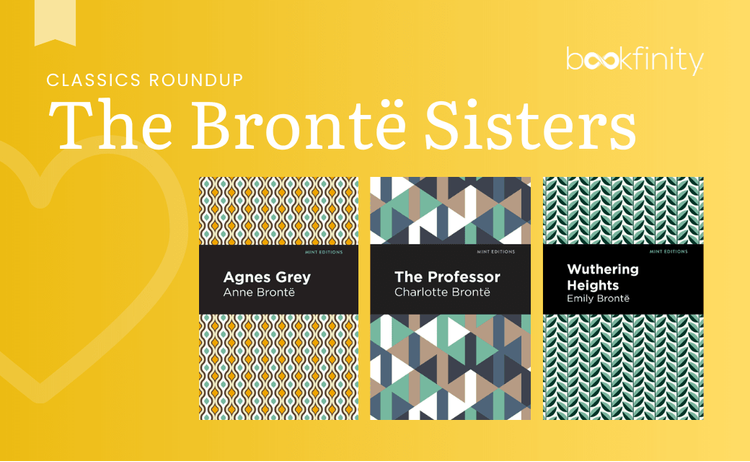
The legacy of the Brontë sisters is still strong hundreds of years later.
Seven classic novels penned by the mysterious Brontë sisters including Anne, Charlotte, and Emily.
We’re celebrating “National Sisters Day,” by reading the Brontë sisters. But before we started reading, we asked ourselves – what makes them still so popular and so well-loved, hundreds of years after their deaths?
There are a few different answers to that. Maybe you chose to read them primarily because the books were intentionally open-ended. If you reread the stories, you may pick up something completely new. Or perhaps you read them because of the stories’ abilities to comment on societal standards and transcend the time of publishing. These women wrote coarsely and typically over uncomfortable subjects. Still, they always had an important lesson, like Jane Eyre’s focus on being authentic in a society that didn’t want you to do that.
The Sisters and Their Mysterious Lives
Or maybe you’re more fascinated that we’re still learning about the sisters, like many others. They were notoriously mysterious women, first publishing under male pseudonyms, and known for living relatively isolated lives in their home by choice. One fascinating quote about them from Catherine Lowell’s The Madwoman Upstairs, “One of the things I most love about the Brontës is that they give the lie to the notion that to be a great writer you have to have epic life experiences – that whole Ernest Hemingway, Jack London thing.”
They had tough lives, losing their siblings and mother young, and their father was relatively absent. Nevertheless, they filled their days reading, playing imaginative games, and eventually discussing what they were writing together. Even as they periodically left home to work and support the family, they would always return with new stories and disgust at societal expectations to discuss.
With notable influences on future authors like Virginia Woolf and Emily Dickinson, these women continue to enchant readers years and years after their initial publication. So, celebrate this week with a reread (or a first read) of these fabulous sisters.
The Brontë Sisters' Legacy of Work
Agnes Grey
by Bronte, Anne
Read an excerpt from Agnes Grey.
Agnes Grey exposes the harsh working conditions of a young governess who's hired by multiple families, including the overly critical Bloomfields and the delusional Murrays.
While on assignment, Agnes endures consistent cruelty, forcing her to look inward for strength and encouragement.
Agnes is a young woman who comes from an impoverished background. Eager for financial independence, she accepts a position as a governess for an upper-class family. Agnes is initially charged with the Bloomfield children, who are unruly and slightly sadistic. The oldest boy, Tom, is particularly threatening, as he likes to capture and harm small animals. Agnes also engages with the extremely wealthy Murrays and their daughters, Matilda and Rosalie, who are in dire need of direction. Agnes attempts to navigate her growing responsibilities, while maintaining her morals and resilience.
In Agnes Grey, Anne Brontë examines a common plight among working-class people. It offers a revealing look at the corruptive nature of wealth, and the moral differences between the haves and the have nots. It goes beyond the surface to expose an unflattering but honest reality.
Shirley
by Brontë, Charlotte
Read an excerpt from Shirley.
"Revolutionary...Brontë's most feminist novel."-Lyndall Gordon
"Charlotte Brontë has us by the hand, forces us along her road, makes us sense what she sees, never leaves us for a moment or allows us to forget her."-Virginia Woolf
Shirley, the second published novel from Charlotte Brontë, is a propulsive social narrative that exposes the discord between the sexes, classes, and economic structure of early 19th century England. Set in 1811-1812 during the strife of the industrial revolution, this classic novel is a story of love struggling against social unrest and the conventions of the roles of women.
When Robert Moore, a struggling mill owner, decides to replace many of his employees with a new piece of machinery, a group of protesters destroys it before it is delivered. As the problems with his mill mount, he starts to become despondent. His cousin Caroline, a frequent visitor to the Moore home is infatuated with Robert, yet he also is inaccessible to her desires. When Caroline is eventually forbidden to visit the Moore home by her overbearing uncle, she is resolved to spend her life doing charitable work. Through her uncle, Caroline is introduced to Shirley Keeldar, a wealthy and independent woman who wants to donate her money to aid the poor. They become very close friends, and eventually, Caroline is convinced that Shirley and Robert will marry. When the threats from laid-off mill workers increase, and soon after the mill is attacked, the conflicts of both love and class explode.
Jane Eyre
by Brontë, Charlotte
Read an excerpt from Jane Eyre.
"At the end we are steeped through and through with the genius, the vehemence, the indignation of Charlotte Bront '"-Virginia Woolf
"Given the action of Jane Eyre, which is in every sense dramatic, there is a pull, all the same, between action and consciousness.-Raymond Williams
"Teaching the true strength of character for generations."-The Guardian
Jane Eyre, (1847) the first novel from Charlotte Bronte, originally published under the pen name "Currer Bell" was an immediate commercial and literary success. This classic work was unprecedented in its forthright reproach towards Victorian social norms, moral duty, and gender inequality; It is likewise one of the most extraordinary stories of love and freedom in the English language.
Jane Eyre, which follows a young woman's passageway into adulthood and the unfolding of her interior emotional states, is a singular work of genre-defying fiction. Its story begins as the eponymous heroine is orphaned and under the care of her aunt, Mrs. Reed, a well-to-do yet heartless guardian. Jane is unfairly punished, and locked into "the red room", where she collapses in fright after an encounter with the apparent ghost of her deceased Uncle Reed. Following the incident, Jane's aunt sends her away to "Lowood", an oppressive school run by the abusive and fraudulent headmaster, Mr. Brocklehurst. After an outbreak of typhoid devastates the school, a new kindly administration is installed. Jane's life finally turns around; she remains at the school for six years and eventually becomes an instructor. After teaching for several years, Jane takes a position as a governess at Thornfield, the residence of the unbridled yet elegant Edward Rochester. As Jane embraces her duties at the estate, she begins to fall in love with her employer, and much to her surprise he asks for her hand in marriage. On the wedding day it is revealed that Edward possesses deep and dark secrets, and Jane flees for the sake of her own emotional integrity. In the ensuing experiences of her retreat, Jane confronts the procession of experiences and the formidable trials of her new life with the command of her unyielding self-determination. A startling modern classic of pronto-feminism, Jane Eyre is one of the most ingenious romance novels ever written.
The Professor
by Brontë, Charlotte
Read an excerpt from The Professor.
The Professor (1857) is English writer Charlotte Brontë's first novel. Rejected by several publishing houses, Brontë shelved the novel in order to write her masterpiece Jane Eyre (1847). After her death, The Professor was edited by Brontë's widower, Arthur Bell Nichols, who saw that the novel was published posthumously. Based on Brontë's experience as a student and teacher in Brussels--which similarly inspired her novel Villette--The Professor is an underappreciated early work from one of English literature's most important writers.
After rejecting a life as a clergyman, William Crimsworth goes to work as a clerk for his brother Edward, a successful businessman. Although he excels, his brother grows jealous of his ability and intelligence, abusing and belittling him until he is forced to quit. Disappointed, he accepts a job at a boarding school in Belgium where, mentored by the kind Monsieur Pelet, William flourishes as a professor. When news of his work reaches Mademoiselle Reuter, a local headmistress at a school for girls, she offers him a position, and William joins her staff. He begins to grow suspicious, however, when he overhears Reuter speaking about him with Pelet and discovers that the pair are engaged to be married. As he begins to second-guess their kindness, he falls in love with Frances, a young teacher-in-training. Harboring her own secret affection for William, Mademoiselle Reuter decides she must dismiss Frances if she is to maintain her control of the young Englishman. Charlotte Brontë's The Professor is a novel of romance, jealousy, and gothic mystery, an early and promising work by one of Victorian England's most prominent writers.
Villette
by Brontë, Charlotte
Read an excerpt from Villette.
Villette (1853) is a novel by English writer Charlotte Brontë. It was the third and final novel she published in her lifetime, followed only by The Professor, her posthumously released first novel which was largely reconceived and rewritten as Villette. Inspired by Brontë's experience traveling and teaching English in Brussels, where she went at the age of 26 with her sister Emily before returning alone the following year, Villette is the story of an Englishwoman abroad and contains the themes of loneliness, secrecy, romance, and tragedy which circulate throughout much of her work.
Following a family tragedy, Lucy Snowe becomes employed as a caregiver by an elderly woman named Miss Marchmont, who treats her kindly and shares stories of life and lost love. When Miss Marchmont dies, Lucy--now without family, home, or employment--decides to leave England for Labassecour, a fictional country based on Brontë's experience of Belgium. She is hired to teach English at a boarding school in the city of Villette, where she meets a strangely familiar English doctor and falls in love with M. Paul Emanuel, a local professor. Although he is a widower, M. Paul faces pressure from family members and religious authorities alike, and is forced to choose between a life of social acceptance and a life with the woman he loves. Amidst these circumstances, and haunted by repeated encounters with a nun rumored to be a ghost, Lucy Snowe must rely on her wits and courage as she suffers through not only intense loneliness, but a lack of control over the events which shape her life.
Charlotte Brontë's Villette is a compelling gothic novel which explores the psychological effects of a lack of agency on its protagonist while illuminating the horrors which loom over everyday life.
Wuthering Heights
by Bronte, Emily
Read an excerpt from Wuthering Heights.
In this new edition of Wuthering Heights by Emily Bronte, re-read the classic love story that has haunted and inspired nearly who've come across it. From the burning love between Catherine and Heathcliff, to the estranged family dynamics at Wuthering Heights, Bronte's novel explores the dangers of a love that remains forever unrequited.
Lockwood, a striking young man from the south of England, is only looking for some respite when he decides to rent a mysterious property in Yorkshire. The landlord, a crotchety old man named Heathcliff, tends to Lockwood as he becomes acquainted with the expansive and haunting property. When inclement weather strikes, Lockwood is forced to stay in the manner at Wuthering Heights, the home of Heathcliff himself. When Lockwood suddenly falls ill, Nelly, the housekeeper tends to him, and spills all the dirty secrets that have been concealed there over the years. Learning about the turbulent relationship between Heathcliff and his deceased lover Catherine Earnshaw, Lockwood struggles to piece together what truly happened on the property at Wuthering Heights.
The stories concealed within Wuthering Heights have been hailed as completely original in the legacy of Victorian-era literature. Emily Bronte created new narrative structures, such as the frame narrative, which had not been seen before. This avant-garde writing style has been celebrated for decades. Wuthering Heights is a love story that will both terrify and enthrall the most daring of readers. Professionally type-set, and including a new section about the author herself, Wuthering Heights is just as riveting today as it was when it was originally published in 1847.
The Tenant of Wildfell Hall
by Bronte, Anne
Anne Brontë's second novel The Tenant of Wildfell Hall centers the arrival of the mysterious Helen Graham and her young son at the old mansion. She captures the attention of many locals, including Gilbert Markham, who becomes gradually infatuated with her.
Helen Graham is a young widow and mother of a five-year-old son. She moves into the Wildfell Hall mansion and attempts to lead a quiet life. Helen is very private and refuses to divulge any details about her personal affairs. Despite reservations, she starts a friendship with Gilbert Markham, who eventually falls in love with her. Helen's secretive nature is a point of contention with neighbors, leading to constant speculation. When targeted by a vulgar rumor, she's forced to reveal the truth about her peculiar behavior and dark past.
In The Tenant of Wildfell Hall, Helen's focus and resilience is undeterred by tradition or social conventions. Brontë gives unprecedented agency to a female protagonist living in the Victorian era. Her story is a testament to the human spirit and the art of self-preservation.

Discover more classics and their modern companion each week.